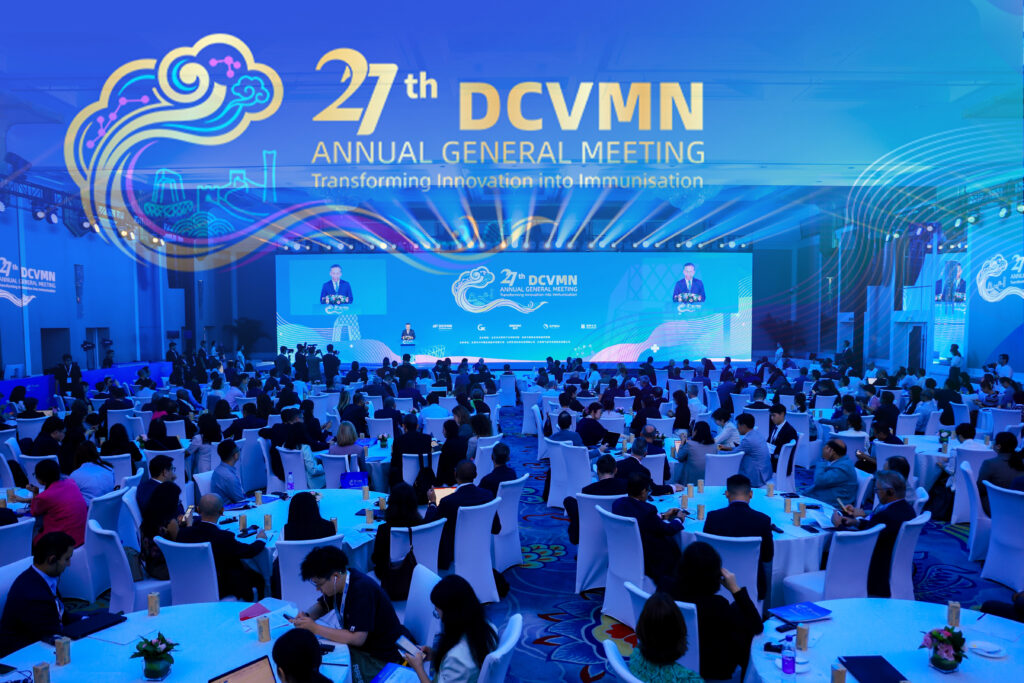
The Developing Countries Vaccine Manufacturers Network convened its 27th Annual General Meeting in Beijing along side the co-hosts BJFP, SINOVAC, Biokangtai and Zhifei, gathering vaccine manufacturers from across the developing world together with the international institutions that shape global immunization. Over three days, under the theme “Transforming Innovation into Immunization,” a single question ran through every session: innovation matters, but how does it reach all those that need to be vaccinated?
The inaugural session set that tone. Welcoming delegates, DCVMN leadership and distinguished guests were united in a message that only grew stronger as the meeting went on. AGM was inaugurated by the Chief Guest Honourable Professor Shen Hongbing, Administrator-NDCPA and Vice Minister, National Health Commission of the People’s Republic of China, in the honourable presence of Mr. Jin Wei, Member of the Standing Committee of the CPC Beijing Municipal Committee and Vice Mayor of Beijing. The World Health Organization, represented by Director-General Dr. Tedros Adhanom Ghebreyesus, recognised that DCVMN members now supply more than seventy percent of the vaccines used across LMICs and observed that regional and national self-reliance will define the next chapter of global health. Speaking for Indonesia’s Ministry of Health, Dr. Lucia Rizka Andalusia captured the heart of the theme: developing-country manufacturers have mastered the science, and the work now is to build delivery readiness alongside innovation rather than after it, because acceptance must be earned before a vaccine ever arrives. Dignitaries and CEOs of Gavi, UNICEF, CEPI, PAHO and the Gates Foundation each pointed in the same direction, noting that in 2025 alone DCVMN members supplied more than sixty percent of the vaccines delivered through Gavi-supported programmes. Furthermore, on behalf of Africa CDC, Dr. Skhumbuzo Ngozwana framed the stakes with an African proverb that echoed through the days that followed: “only a fool builds a shield in the middle of a battle,” and explained that Africa is building its manufacturing capacity, regulatory systems and financing architecture now, while there is still time to build them well.
Much of the meeting was devoted to the science that makes this possible, and the pipeline on display was rich. Sessions traced advances in glycoconjugate vaccines, progress in Shigella and PCV conjugate trials, and the industrialization of vaccine production in Latin America, with a welcome emphasis on measuring efficacy after vaccination rather than before it alone. Africa’s mRNA story stood out, with the RNA Cooperative bringing three DCVMN members together to advance candidates as ambitious as a multi-targeted malaria vaccine. On combination vaccines, the guiding principle was clear and often repeated: vaccines should be designed around the needs of immunization programmes, not around what is easiest to manufacture. Developers were invited to stay creative in their exploration of adjuvants, conjugates and new platforms.
Yet the meeting was equally honest that science alone is not enough. Innovation must be financed, regulated, and absorbed by an ecosystem ready to receive it. On financing, delegates spoke frankly about the “valley of death” where a growing manufacturer risks being stranded at fill-and-finish, and heard how partners including the World Bank Group, CEPI and the Gates Foundation are building end-to-end financing that helps manufacturers become self-sufficient long after an investment concludes. As the funding landscape tightens and country-led prioritization creating new market imbalances, deliberate financing and market shaping become ever more necessary to keep supply diversified and reaching the countries that depend on it. On regulation, the direction is toward reliance: a single trusted assessment report that agencies across countries can stand behind, supported by digitalization that lets them share assessments simultaneously. Stronger national regulatory systems, panelists agreed, grow more essential as the system matures, since reliance is the foundation on which pooled procurement will ultimately be built. And on capacity, the message was that technology transfer is a means and not an end: capability must be built across the whole chain, above all through a skilled workforce trained to regional need, with local investment to ensure the talent that is trained has every reason to stay.
The path from the laboratory to the community ran through delivery, and here digitalization emerged as the connective tissue. Delegates heard how digital microplanning locates the communities a vaccine has not yet reached, how digital payment supports immunizers, and how triangulating surveillance, immunization and impact data reveals whether programmes are truly succeeding. On artificial intelligence, members were grounded rather than dazzled: the honest first step is to digitalize their own processes, and only then to build AI upon them. A dedicated session on AI in vaccine design, manufacturing and supply chains held both promise and caution together, recognising AI’s power to accelerate discovery and optimise production while naming its risks plainly, and concluding that as the technology grows more powerful, safeguards and regulation become more essential still, though doing nothing is not an option.
Running beneath these technical themes was a human one: trust. In a session on building vaccine confidence, panelists were reminded that confidence is shaped across the entire vaccine lifecycle rather than won at the moment of delivery, and that behavioural and anthropological insight should be brought upstream into research itself. As misinformation spreads, the AGM heard repeatedly, confidence must be built deliberately and early rather than repaired late, with manufacturers, institutions and the media all partners in earning it.
Finally, the meeting turned to preparedness. Sessions on pandemic and PHEIC readiness made the case that preparedness is built between crises, not during them, and that routine orders are what keep manufacturers viable and competitive so they are ready to respond at speed when an emergency comes. Demand, panelists concluded, is the force that shapes manufacturing capacity, which is why support for pooled procurement, both regional and global, grows more important as the threat of the next pandemic sharpens.
Beyond the sessions themselves, the 2026bAnnual General Meeting reaffirmed its value as one of the very few places where vaccine manufacturers from developing countries meet one another, and meet international institutions, face to face. It remains a fertile ground for partnership, where conversations become collaborations and collaborations become signed agreements. As the challenges facing global immunization grow, that convening power becomes more and more valuable. Closing the meeting, DCVMN reflected on a field that already has the science and the track record, and on the shared task ahead: to connect innovation to delivery, to sustain the partnerships that make it possible, and to keep every link in the chain strong, so that innovation can reliably become immunization.