DCVMN International joined the global health community in Berlin for the 2026 World Health Summit, held from 11 to 13 October. Over the course of the Summit, DCVMN CEO Mr. Rajinder Suri took part in a series of side events that collectively captured where the architecture of pandemic preparedness, local manufacturing, and international partnership currently stands and where it is heading.
Celebrating a DCVMN Member at the Future of Dengue Technologies
On 11 October, the Global Coalition for Local and Regional Production, Innovation and Equitable Access convened its side event, “The Future of Dengue Technologies: First Call for Proposals,” at which the five proposals shortlisted to advance to the next phase of the Coalition’s inaugural call were announced. Out of 25 submissions received, DCVMN member Panacea Biotec was the only applicant selected in the vaccines category, with a proposal for a single-dose tetravalent dengue vaccine.
DCVMN warmly congratulates the Panacea Biotec team on this important recognition, a milestone that reflects the quality and ambition of innovation emerging from developing-country vaccine manufacturers, and a tangible step from international commitment to concrete initiatives capable of strengthening local and regional production, fostering innovation, and expanding equitable access to health technologies in developing countries.
Keeping Platforms Warm: Enabling Sustainable Outbreak-Ready Vaccine Manufacturing
Later that day, Mr. Suri joined the senior-level roundtable co-hosted by CEPI and RVMC, titled “Keeping Platforms Warm: How to Enable Sustainable Outbreak-Ready Vaccine Manufacturing.” The discussion convened approximately 25 senior representatives from across the global health community including governments, regional bodies, vaccine manufacturers, procurement organisations, financing institutions, philanthropies, civil society organisations, and global health partners, to examine how demand-side interventions and diversified manufacturing portfolios can support sustainable outbreak-ready vaccine manufacturing.
Among his remarks, Mr. Suri underlined the need for advance funding arrangements, such as the arrangement with the Serum Institute of India, and for regional manufacturing supported by RVMC and DCVMN. He stressed that keeping manufacturing facilities warm requires stronger demand visibility, a challenge that only grows more pressing as the pace of emerging outbreak threats continues to accelerate. In response, he offered a model that applies AI across the full cycle from outbreak signal to dose demand, arguing that the core challenge is not a data gap but a translation gap. This gap, he explained, can be bridged by applying AI in the supply chain to generate an executive scenario dashboard offering a range of dose-demand projections with bounded uncertainty, rather than a single-point estimate.
Partnerships and Innovations for Global Health with BMZ
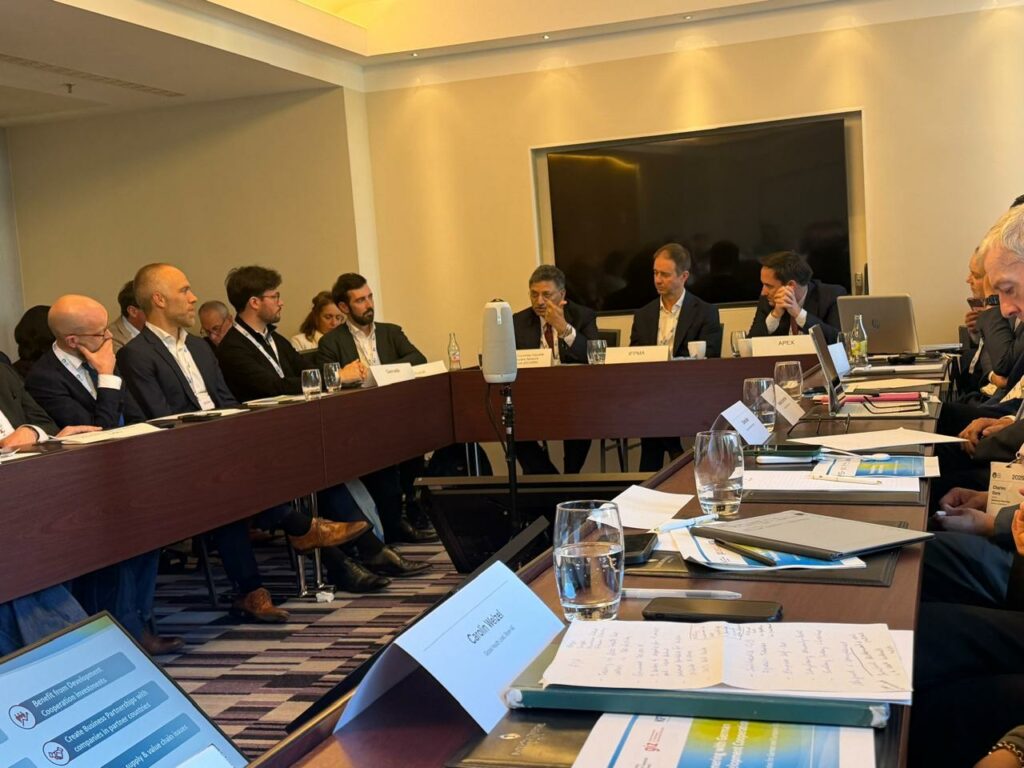
On 12 October, Mr. Suri took part in the “15th Round Table on German Development Cooperation and Health Industry: Partnerships and Innovations for Global Health,” hosted by the German Federal Ministry for Economic Cooperation and Development (BMZ) and chaired by Deputy Director General Dr. Tania Rödiger-Vorwerk. The session brought together representatives of the German and European health industry for an open exchange on cooperation opportunities with German development cooperation.
Mr. Suri highlighted the foundational role of BMZ and the Deutsche Gesellschaft für Internationale Zusammenarbeit (GIZ) in building Africa’s sovereign vaccine capacity. Their joint efforts align directly with the African Union’s PHAARM initiative to lift the continent to 60% self-sufficiency by 2040 and are central to Team Europe’s Manufacturing and Access to Vaccines (MAV+) initiative. While BMZ serves as the political driver and financial engine, GIZ is the implementing arm, turning funding into tangible infrastructure through initiatives such as the Back-up Health Programme, which partners with national regulators including SAHPRA and Ghana’s FDA to digitise processes and advance them toward WHO Prequalification standards, alongside a strong focus on workforce development, one of the sector’s most persistent bottlenecks.
A Continued Commitment to Representation and Partnership
DCVMN’s participation across the 2026 World Health Summit reflects the network’s ongoing commitment to representing the perspective of developing-country vaccine manufacturers in the conversations shaping global health. Through recognising member achievements, bringing the manufacturer voice into high-level policy and technical discussions, and actively exploring partnership opportunities with public and private stakeholders alike, DCVMN continues to work alongside its members to build the systems, financing structures, and partnerships that will sustain equitable vaccine access in the years ahead.