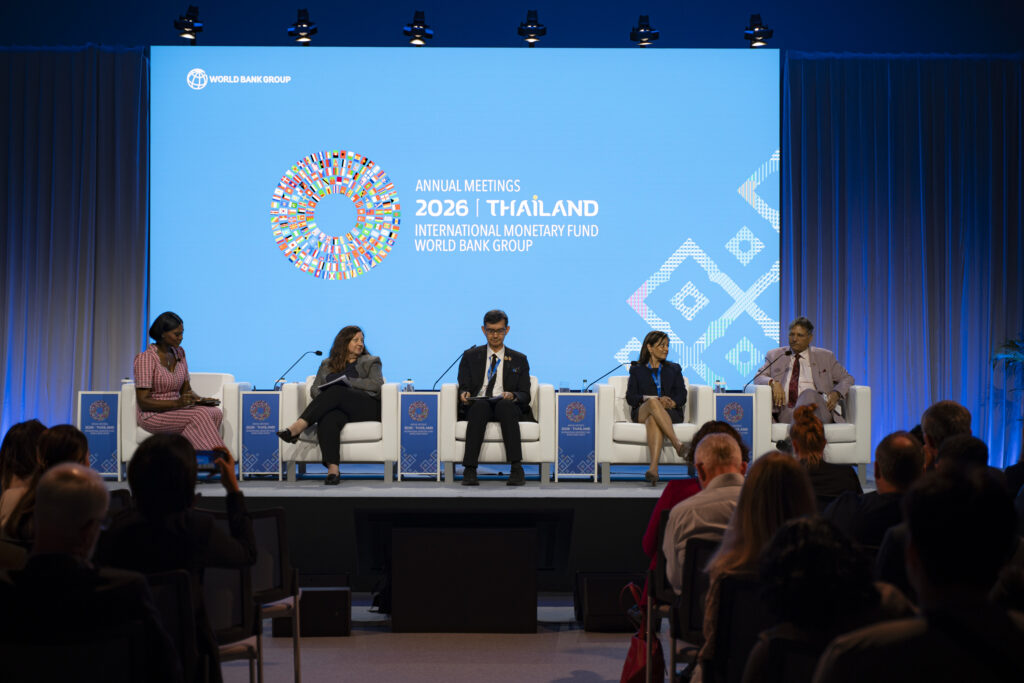
During the The World Bank Group–International Monetary Fund Annual Meeting in Bangkok, “Health Works: Private Capital, Public Good” convened government, finance, and private sector leaders to explore how greater investment in health can translate ambition into measurable results.
In the Opening Conversation, a headline moment was the announcement by Mr. Paschal Donohoe, Managing Director and Chief Knowledge Officer, World Bank, of USD 625 million for pandemic preparedness and response in the ASEAN region, including a USD 20 million envelope from CEPI, as confirmed at the event by Ms. Aurélia Nguyen, Deputy CEO, CEPI with Ms. Éléonore Caroit, Honorable Minister Delegate for International Partnerships France, at the stage in the presence of Mr. Pattana Promphat, Honourable Minister of Public Health Thailand.
DCVMN CEO, Rajinder Suri, joined one of two panels that followed, titled ,” Health Security — From Vulnerability to Resilience,” alongside Honourable Ms. Kirsty McNeill, Minister of State for International Development, UK; Dr. Nakorn Premsri, Director, National Vaccine Institute, Thailand; and Ms. Priya Basu, Executive Head, Pandemic Fund. While the first panel was joined by Dr. Heidy Rombouts, PhD, DG International Cooperation and Humanitarian Affairs, Ministry of Foreign Affairs Belgium, Ms. Kalpana Kochhar, Interim President, Global Policy and Advocacy Division, Gates Foundation; and Ms. Stephanie Sievers, Managing Director, Philips APAC.
When asked about the key enablers for building a regional manufacturing agenda for pandemic preparedness, DCVMN CEO pointed to four pillars:
🔸 Timely access to novel technology, including complete know-how of Tech-transfer, not just IP
🔹 “Minus zero-day” funding, innovative mechanisms spanning the full arc from discovery to scale-out
🔸 Regulatory reliance and harmonization, during COVID-19 over 5,000 regulatory approvals were granted in a single year, yet the sector has since largely returned to pre-pandemic patterns
🔹 Strong political will, without which the other three cannot deliver
On how public and private sectors could come together more effectively in East Asia, Mr. Suri identified regulatory fragmentation across borders as the biggest barrier, a challenge that only grows more consequential as new modalities and markets emerge, calling for Mutual Recognition Agreements and harmonised data standards. He also underlined the unpredictability of demand that leaves manufacturers uncertain about the capacity to keep warm, and shared that DCVMN is launching a pilot to convert disease signals into dose-level demand, with potential for broader scale-up.
On the margins of the meeting, Mr. Suri had the opportunity to engage directly with Honourable Minister Mr. Promphat, Mr. Donohoe, Ms Mamta Murthi, Ms Monique Vledder and Ms Carryn from the World Bank Group, exchanges that reflect how DCVMN works to connect and align industry, national authorities, and international institutions.