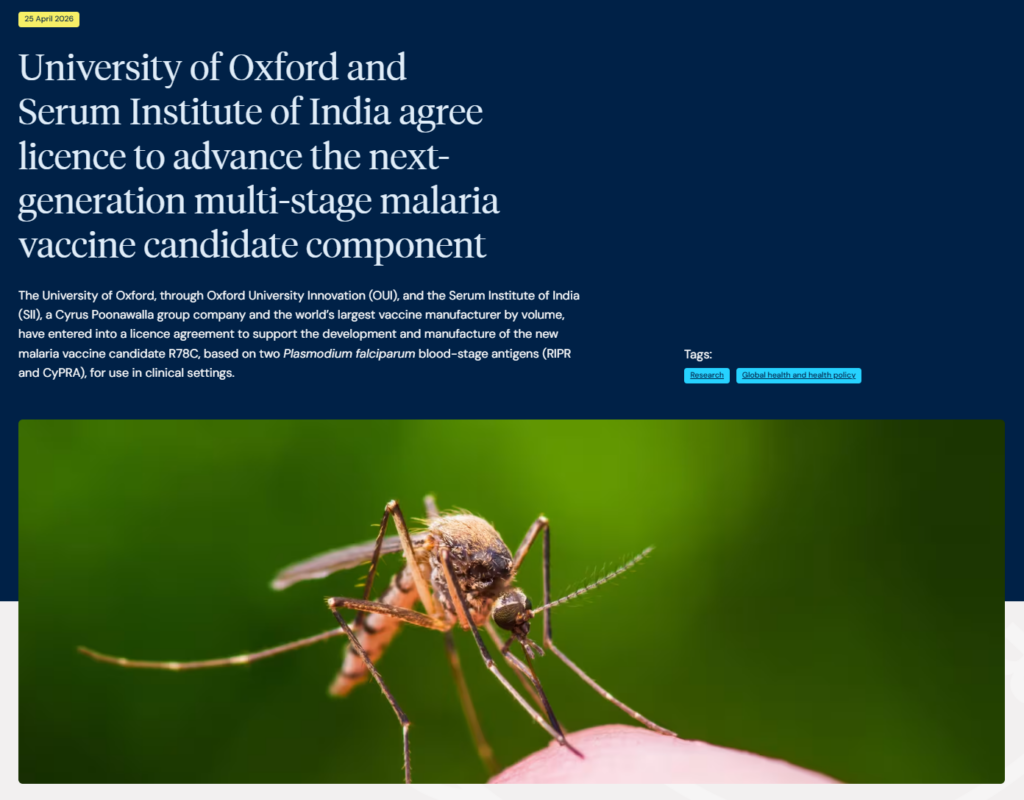
Join us in celebrating an important milestone for our member company, Serum Institute of India, which has signed a new licence agreement with the University of Oxford to develop the next-generation multi-stage malaria vaccine candidate component, R78C.
The agreement grants SII a non-exclusive, worldwide licence to develop R78C as part of a multi-stage malaria vaccine designed to target the parasite at multiple points in its lifecycle, with the aim of improving both the efficacy and durability of protection. It builds on a longstanding collaboration between Oxford and SII, including the 2019 R21 licence and subsequent work on the RH5.1 blood-stage candidate, and will support the continued development, large-scale manufacturing, and potential future commercialisation of the multi-stage vaccine.
The significance of this milestone is hard to overstate. Malaria remains one of the world’s deadliest diseases, claiming over half a million lives every year, most of them children under five in sub-Saharan Africa. Every advance toward a more effective malaria vaccine is a direct contribution to one of the greatest unmet needs in global health.
This news is a powerful reminder of what the DCVMN network represents. Our members are not just manufacturing vaccines at scale, but they are at the forefront of vaccine innovation, partnering with leading research institutions to bring next-generation technologies from the lab to the communities that need them most. It is precisely this combination of scientific ambition, large-scale manufacturing capacity, and deep commitment to equitable access that defines the role of developing-country vaccine manufacturers in shaping the future of global health!
Heartiest congratulations to Serum Institute of India and to the University of Oxford on this milestone. We look forward to following the progress of R78C, and to the contribution it will make to the fight against malaria.
➡️ Read the full announcement here: https://www.ox.ac.uk/news/2026-04-25-university-of-oxford-and-serum-institute-of-india-agree-licence-to-advance-the-next