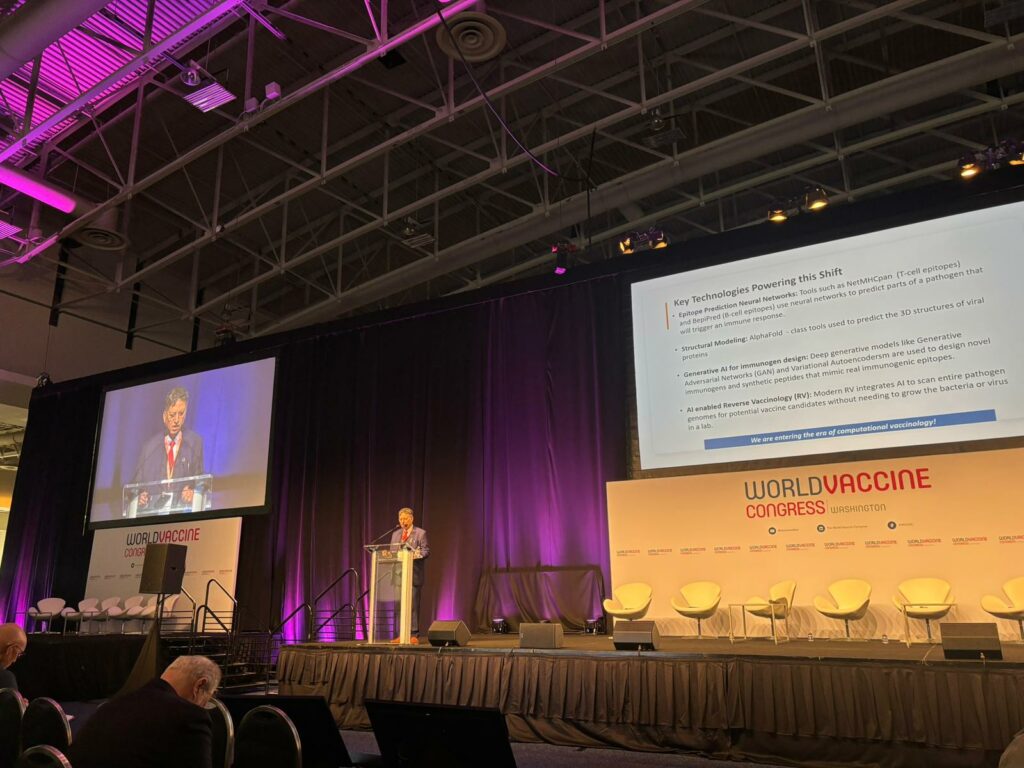
Last week, DCVMN CEO Rajinder Suri represented the network at the World Vaccine Congress in Washington, D.C. which is one of the leading global gatherings in the vaccine field. During the event, he delivered a keynote address, participated in a high-level panel discussion alongside DCVMN Board members, and held a series of bilateral meetings with key global health stakeholders.
Keynote Address: AI and the Future of Vaccine Innovation
In his keynote, Rajinder presented a forward-looking perspective on the role of artificial intelligence (AI) across the vaccine lifecycle. He demonstrated how AI is already being applied in areas such as antigen discovery and vaccine design, supported by real-world case studies, including examples from DCVMN member companies, thus highlighting how the field is evolving from largely empirical approaches to increasingly predictive science.
He further explored the growing use of AI in structural modelling and generative AI for immunogen design, as well as its applications in clinical development and regulatory science, where it can support and enhance traditionally manual systems. Across these use cases, AI is emerging as a powerful tool to strengthen efficiency, accelerate timelines, and enhance the global competitiveness of vaccine manufacturers in developing countries.
At the same time, Rajinder underscored that responsible innovation remains non-negotiable. While AI presents significant opportunities to help close existing gaps, it also introduces risks that must be carefully managed to avoid reinforcing inequalities.
Looking ahead, he outlined key priorities for the sector, including:
- Strengthening digital infrastructure
- Expanding academic-industry partnerships
- Piloting AI applications in antigen prediction and process optimization
- Engaging regulators to develop AI evaluation frameworks
- Investing in workforce development and digital skills
His central message was clear: AI can serve as a strategic equalizer, but only if its adoption is inclusive, responsible, and aligned with the realities of manufacturers in LMICs.
High-Level Panel: Sustainability, Resilience, and Decentralization
Rajinder then joined a distinguished panel moderated by Dr. Gregory A. Poland, Director of the Mayo Vaccine Research Group, Mayo Clinic, alongside DCVMN Board members Dr. Rosane Cuber Guimarães, General Director of Bio-Manguinhos/Fiocruz, and Rachel Park, Director of International Business at EU Biologics, as well as Rakesh Lothe, Senior General Manager of Production at Serum Institute of India, and Amin Khan, Chief Scientific Advisor at Afrigen.
The panel explored three core themes central to DCVMN’s mission: sustainability in manufacturing, regulatory harmonization, and technology transfer.
Each speaker brought a distinct perspective:
- Rajinder Suri on sustainability, took the opportunity to offer a first glimpse of an exciting in progress DCVMN initiative: Net Zero Project developed in collaboration with UNICEF and DCVMN members across multiple regions, more on this to come! He also emphasized the importance of strengthening manufacturers through targeted initiatives such as DCVMN’s technology transfer training programmes, reinforcing the network’s role in building sustainable and resilient vaccine manufacturing capacity.
- Rakesh Lothe highlighted the complexities of sustainable vaccine manufacturing at scale, drawing on the experience of Serum Institute of India as one of the world’s largest producers. He addressed challenges in technology transfer, ensuring process consistency, and integrating green technologies, while also reflecting on the trade-offs manufacturers must navigate.
- Rachel Park focused on the intersection of sustainability and equity, emphasizing that progress toward net zero must not come at the expense of vaccine access. She also underscored how high-level regulatory recognition can empower local manufacturers, particularly in Africa, to build and strengthen their own production ecosystems.
- Rosane Cuber Guimarães shared insights from Bio-Manguinhos/Fiocruz, including ongoing collaboration with Pan American Health Organization to promote regulatory convergence across Latin America. She also highlighted the potential of modular manufacturing units to expand access, and Bio-Manguinhos’ participation in DCVMN’s Net Zero pilot project, outlining the motivations and expected impact of this initiative.
Strengthening Partnerships and Global Engagement
Beyond the stage, Rajinder held a series of bilateral meetings with key partners, including the World Bank, International Finance Corporation, International Vaccine Institute, and Regionalized Vaccine Manufacturing Collaborative, further advancing DCVMN’s efforts to strengthen collaboration and visibility for developing-country manufacturers.
Amplifying the Voice of Developing-Country Manufacturers
Participation in global platforms such as the World Vaccine Congress remains critical to DCVMN’s mission. These engagements ensure that the perspectives and priorities of developing country vaccine manufacturers are represented in shaping the future of global health.
As the vaccine ecosystem continues to evolve through digital transformation, sustainability imperatives, and shifting global dynamics, DCVMN remains committed to supporting its members and advancing equitable, resilient, and innovative vaccine manufacturing worldwide.