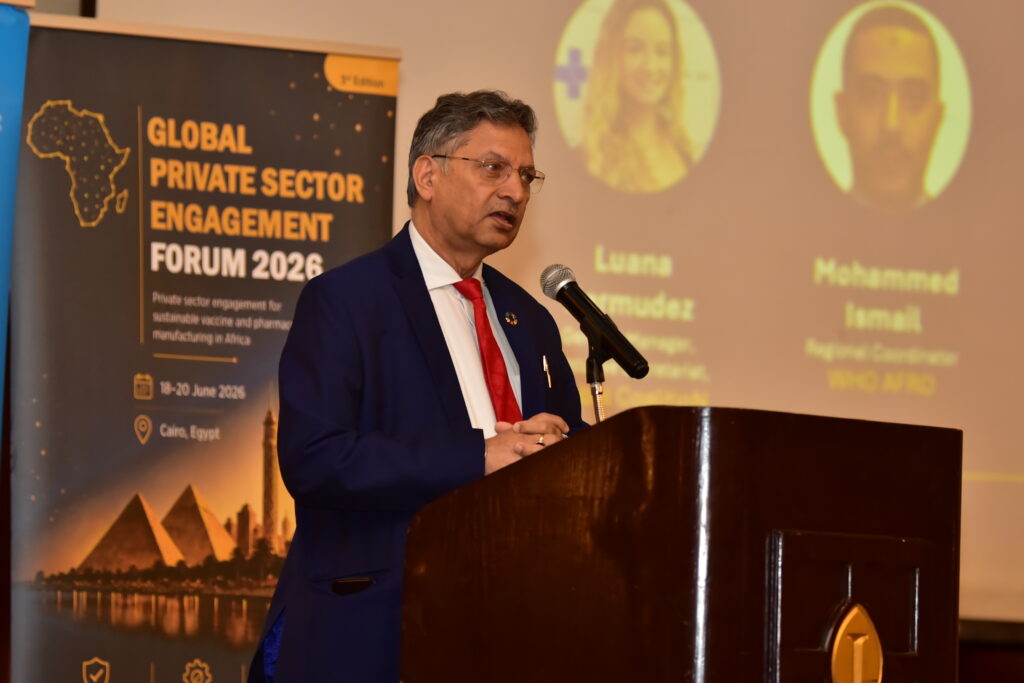
Last week, Cairo hosted the 3rd Global Private Sector Engagement Forum (PSEF2026), convened by the World Health Organization together with EU Global Gateway Africa, and German Development Cooperation(giz), a forum that DCVMN CEO Rajinder Suri was honoured to take part in, bringing the voice of developing-country vaccine manufacturers to the conversation.
On June 19th Mr. Suri delivered a keynote address on lessons learned from different WHO regions in building sustainable vaccine manufacturing. Drawing on the collective experience of DCVMN members across Asia, Africa, and Latin America, the keynote focused on what it actually takes to make local vaccine manufacturing viable over the long term to have a resilient health systems, rather than just as a response to a crisis.
He then chaired a session titled “Talents for Transformation — Strengthening Africa’s Biomanufacturing Workforce through Regional and Global Partnerships,” which spoke to one of the most foundational, and often most overlooked, conditions for sustainable manufacturing: the workforce. The session showcased concrete progress in workforce development for local pharmaceutical manufacturing, from Africa CDC’s Regional Capability and Capacity Networks (RCCNs) across the continent, to the WHO Global Training Hub for Biomanufacturing (GTH-B), and to International Vaccine Institute (IVI)’s multi-stakeholder initiatives such as the BRIGHT Fund.
Mr. Suri was joined by Dr. Jicui Dong, Unit Head, Products Policy, Access and Manufacturing Support Unit at WHO; Dr. Abebe Genetu Bayih, Lead of the Platform for Harmonized African Health Products Manufacturing (PHAHM) at Africa CDC; Dr. Sushant Sahastrabuddhe, MD, MPH,MBA, Associate Director General, Innovation Initiatives & Enterprise Development at IVI; Dr Nargisse El Hajjami El Hajjami, Head of Business Development & Strategic Partnerships EMEA at Sartorius; and Dr. Dalia Abdelrahim Sayed, Director of BCG Manufacturing & Development at VACSERA. We extend our thanks to each of them for an exchange that was both grounded and forward-looking.
Building sustainable vaccine manufacturing in developing countries is ultimately a question of converging conditions: policy, finance, partnerships, and skilled people working together, and DCVMN will continue to contribute to that convergence.